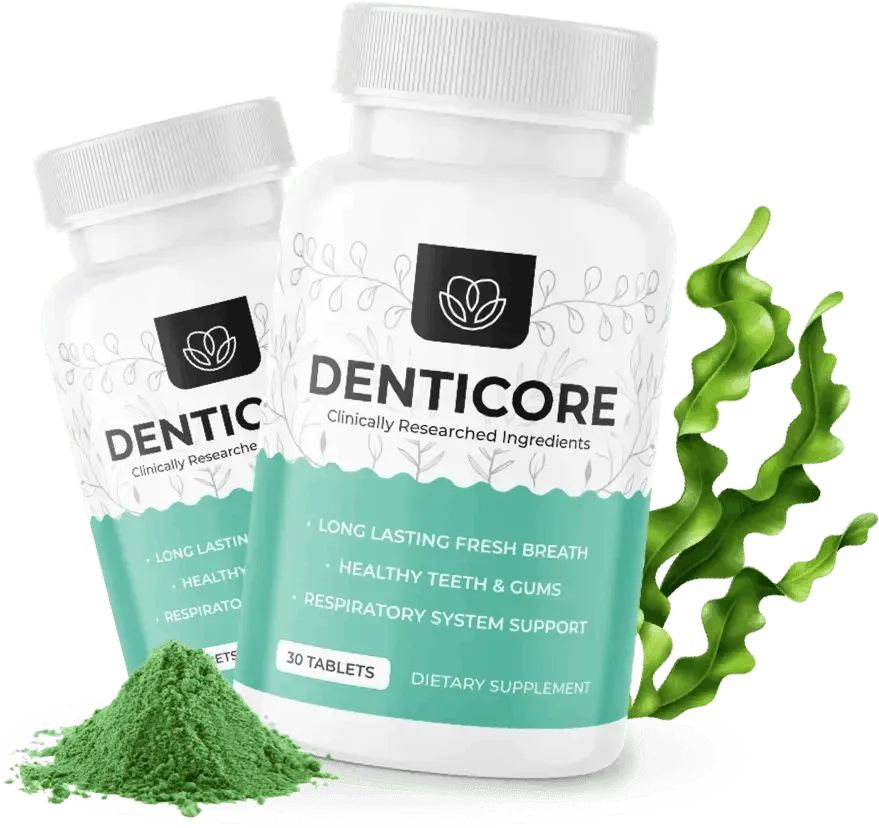
Denticore has joined the crowded ranks of direct-to-consumer oral health supplements promising to do what your toothbrush cannot: reach beneath the surface, “oxygenate” your gums, and rebuild the foundation of a healthy mouth from the inside out. The pitch is polished, the testimonials are glowing, and the price—$69 for a single bottle—signals confidence.
But beneath the sales page lies a familiar pattern: a proprietary blend with partial dose disclosure, no published trial of the finished formula, a mechanism that mainstream dentistry does not recognize, and a distribution channel riddled with lookalike sites that void the guarantee. This review separates what Denticore claims from what the evidence actually supports—so you can decide whether it belongs in your bathroom cabinet or your refund request queue.
What Is Denticore?
Denticore is a once-daily oral health supplement sold as a soft chewable or swallowable tablet, depending on the listing. It is marketed for gum health, enamel strength, fresh breath, and “deep cleansing” of the respiratory and oral systems. The recommended regimen is one tablet per day, and a single bottle is designed to last 30 days.
The product is sold exclusively through its official sales funnel, processed through ClickBank or DigiStore24. It is not available in pharmacies, supermarkets, or major marketplaces in any verified official capacity. That distribution detail matters more for Denticore than for most supplements, because the most intuitive domain currently routes to a domain-marketplace sale page rather than a store. Anyone typing the obvious URL lands nowhere useful, which is precisely how mirror sites capture traffic.
The core marketing narrative is unusual even by supplement standards. Denticore claims that bacteria travel from the airways into the mouth and starve the gums of oxygen, and that the tablet “deep cleanses” the respiratory system to restore that oxygenation. No study on the vendor’s own references page supports this mechanism, and three of its cited references are about strontium, an element that is not even in the product.
The Ingredients: Four Disclosed Minerals and a 120 mg Mystery Blend
Denticore’s label is a partial transparency story. It discloses amounts for four minerals but hides the quantities of its botanical ingredients inside a proprietary blend.
The Disclosed Minerals
| Ingredient | Amount per Serving | Daily Value Context |
|---|---|---|
| Calcium | 20 mg | Small fraction of daily needs |
| Iodine | 50 mcg | ~33% of adult daily value |
| Copper | 1.7 mg | 189% of daily value |
| Chromium | 50 mcg | Meaningful supplemental dose |
The Proprietary Blend (120 mg total, individual doses undisclosed)
- Chlorella vulgaris
- Sodium copper chlorophyllin
- Boron citrate complex
- Shilajit extract (standardized to 5% fulvic acid)
The tablet is sweetened with xylitol and flavored with peppermint.
The critical transparency problem is the blend. Even where the minerals are disclosed, the botanical doses are not, which means no consumer or clinician can compare the formula against the research that supposedly supports it—or calculate total exposure to copper and iodine from combined sources.
Does the Science Support the Claims?
Calcium: The Only Ingredient With Unambiguous Standing
Calcium is the one entry with genuine dental relevance—but even here, the framing matters. The American Dental Association names calcium among the ions needed to remineralize enamel and dentin, delivered through diet and saliva as part of normal nutrition alongside phosphate and fluoride. A 20 mg tablet is not a therapeutic dose for enamel repair; it is a small nutritional contribution.
Iodine: Plausible, Unproven
Iodine receives the most interesting treatment in the literature. A 2020 authoritative review acknowledges iodine’s broad-spectrum antibacterial reputation and interest in caries and periodontitis applications—then states plainly that more convincing clinical research is required to validate efficacy. The sales page’s claim that iodine “stops tooth decay and gum disease” outruns that evidence considerably.
Copper: Animal Models Only
Copper sounds scientific because enamel chemistry genuinely involves trace metals. But the same review is careful: copper demonstrates anti-caries effects in animal models, a long step short of human proof, and its effects at dietary concentrations are small.
Chromium: No Dental Evidence
Chromium’s inclusion is the clearest head-scratcher. Its validated human role involves blood sugar regulation. Nothing located in the evidence review connects chromium supplementation to teeth or gums. It is a nutrient borrowed from metabolic health and re-labeled with a dental promise it never earned.
Chlorella: No Oral Outcomes
A 2026 review of algae supplementation found modest aerobic-performance effects for spirulina and chlorella, with nothing oral-specific. Human trials concentrate on exercise performance and general markers, not gum disease or enamel.
Chlorophyllin: A Deodorant History, Not a Gum Treatment
Chlorophyllin has decades of use as an internal deodorizer and some laboratory antimicrobial data, but controlled dental trials are missing from the evidence searches. The formula delivers a small chlorophyllin dose with what reviewers described as a 1950s-era deodorant rationale—not a modern gum therapy.
Boron: No Gum-Disease Evidence
Boron appears throughout bone-health discussions without ever anchoring a gum-disease outcome. The only periodontal trials involving boron compounds used boric acid irrigated directly into gum pockets by a dentist—a delivery method and dose entirely unrelated to a swallowed tablet.
Shilajit: Heavy-Metal Variability
Shilajit is a traditional remedy, and a 2024 review describes it as containing around 65 heavy metals, including lead, arsenic, cadmium, and mercury, with composition varying by region and processing method. Humic compounds may bind some metals, but sourcing and third-party testing determine whether a shilajit product is benign or burdensome. The Denticore sales page offers no certificates of analysis.
The Pattern: Borrowed Ingredients, Lost Evidence
The formula follows a recognizable pattern: ingredients are taken from other wellness categories where they have at least preliminary stories—chromium from blood sugar, chlorella from athletic recovery—then re-labeled with dental promises. Each hop loses whatever evidence existed at the origin, leaving a name with no dental data behind it at all.
Safety and Side Effects: An Evidence Vacuum
No Published Safety Study
The truthful starting point on Denticore side effects is stark: no independent safety study of the finished formula exists, and the botanical doses are not published anywhere on the sales page. Any specific safety promise—including the page’s claim of no notable side effects across tens of thousands of customers—is marketing rather than measurement.
Iodine: A Narrow Therapeutic Band
Iodine sits closest to a genuine safety edge because intake needs occupy a narrow range: too little harms thyroid function, and too much disturbs it as well. Denticore prints 50 mcg, roughly a third of the adult daily value. People with thyroid conditions, those taking thyroid medication, and anyone using iodized salt plus other supplements should treat this as a reason to consult a clinician before adding more.
Copper: 189% of the Daily Value
Denticore alone supplies 1.7 mg of copper—189% of the daily value. Individuals with Wilson’s disease or other copper-handling disorders manage intake medically, and excess copper can cause gastrointestinal distress. Anyone already taking a copper-containing multivitamin should be cautious about stacking.
Shilajit: The Heavy-Metal Question
The heavy-metal variability of shilajit is not a theoretical concern. Without independent certificates of analysis, buyers cannot know whether a given batch is clean. Independent testing is the bar, and the sales page offers none.
Chromium and Diabetes Medications
Chromium can interact with diabetes medications through glucose pathways. Anyone on blood-sugar-lowering drugs should clear the supplement with a pharmacist or physician first.
Who Should Talk to a Clinician First?
NIH consumer guidance states plainly that supplements can interact with medications or pose risks with certain medical problems or upcoming surgery. Applied here, the caution list includes thyroid patients, pregnant or nursing women, organ-transplant or kidney patients, people on diabetes medication, and presurgical patients.
What Mild Effects Might Look Like
With no trial data, expectations come from ingredient classes. Mineral chewables taken on an empty stomach sometimes cause brief nausea or a chalky aftertaste; food usually fixes that.
visit denticore official website
Customer Reviews and Complaints: Four Predictable Failure Modes
Denticore complaints follow four channels: expectation gaps, unverifiable review badges, mirror-site purchases, and refund friction.
Complaint 1: Results Did Not Match the Pitch
The sales narrative is unusually ambitious: bacteria migrating down airways, oxygen-starved gums, a chewable that restores oxygenation. Mainstream dental guidance describes gum disease as plaque-driven and managed through professional cleaning plus hygiene. The airway model does not appear in that framework, and the formula has no published trial of its own. The gap between story and record makes underwhelming results almost guaranteed for buyers who believed the story.
What a realistic outcome actually looks like: calcium, iodine, and the other minerals support normal body functions. A person whose diet already covers those functions should expect to notice nothing at all. A person with a genuine dietary gap might eventually register general wellbeing effects measured in weeks, not days—and neither scenario includes stronger gums on its own, because nothing in the formula has been shown to act on gum tissue directly.
Complaint 2: Unverifiable Review Badges
The sales page displays a perfect score attributed to nearly twenty thousand reviews and a customer base above sixty-seven thousand—neither linked to an independent platform. Buyers who later search for verifiable third-party ratings often feel misled by what they now read as manufactured social proof. Those badges are marketing claims, not audited statistics.
Third-party trust scores for the primary domain sit at 36 out of 100, a low-trust result, and at least one other Denticore domain has been reported as a possible scam.
Complaint 3: Mirror Sites and Lost Guarantees
This is the most consequential category because money actually disappears. Searching for Denticore returns multiple domains claiming official status, and the most intuitive domain itself routes to a domain-marketplace sale page. Buyers who purchase through lookalike funnels discover that the 60-day email-refund promise does not reach their transaction. No official purchase record means no official guarantee.
Complaint 4: Refund Friction
The published refund process is simple: within 60 days of receiving the product, email the address supplied with your order. But the guarantee belongs only to orders placed through the official ClickBank funnel. ClickBank processes returns within its 60-day policy for transactions through its system, providing a second layer of recourse that mirror purchases lack.
Price, Packages, and the Channel Problem
The official price ladder is transparent:
| Package | Price per Bottle | Total (approx.) | Shipping |
|---|---|---|---|
| 1 bottle | $69 | $69 | Free (US) |
| 3 bottles | $59 | $177 | Free (US) |
| 6 bottles | $49 | $294 | Free (US) |
The regular price is framed as $99 per bottle, making the ladder look like a discount. Two cautions apply. Bundle pre-selection is the classic place totals drift upward, so read the order summary line by line before confirming. And treat any dramatically lower price found elsewhere as a warning rather than a win, because the discount comes from removing your protections.
The channel problem is the single most important practical issue with Denticore. Because the obvious domain is parked, and because search results are crowded with review-shaped pages whose every link leads to one checkout, the review you read and the store you reach may both be parts of the same sales machine.
Denticore vs. Oral Probiotics: A Different Mechanism, Weaker Evidence
Denticore is a swallowed tablet that works systemically—absorbed through the digestive tract, with ingredients traveling through the bloodstream to affect oral tissues indirectly. This is fundamentally different from oral probiotics that dissolve in the mouth to colonize the tongue and tonsils with beneficial bacteria.
That distinction matters for evidence. Oral probiotic strains have strain-level randomized controlled trials and Cochrane citations behind them. Denticore’s evidence is ingredient-level, indirect, and often borrowed from unrelated fields. For issues rooted in the oral microbiome—bad breath, bleeding gums, gingivitis—the evidence favors targeted oral probiotics over a systemic mineral-and-chlorophyll tablet.
The Verdict: Is Denticore Worth It?
Denticore is a conditional product with meaningful transparency and safety problems.
The Case Against
- No published trial of the finished formula. The mechanism—airway bacteria starving gums of oxygen—is unsupported by the vendor’s own references, three of which are about strontium, an ingredient not in the product.
- Botanical doses are hidden inside a 120 mg proprietary blend, making comparison to research impossible.
- Most ingredients lack dental evidence. Chromium, chlorella, boron, and chlorophyllin have no controlled dental trials supporting the claims made for them.
- Copper at 189% of the daily value creates a real risk for anyone stacking multivitamins or with copper-handling conditions.
- Shilajit carries documented heavy-metal variability with no third-party testing disclosed.
- The channel is a minefield. The obvious domain is parked, mirror sites void the guarantee, and review badges are unverifiable.
- Low third-party trust scores reflect these structural risks.
The Case For
- The label discloses four mineral doses, which is more than many competitors offer—though the botanical blend remains opaque.
- The 60-day ClickBank refund is real when purchased through the official funnel, and ClickBank—not the vendor—processes returns, reducing hassle risk.
- Xylitol and peppermint are legitimate, well-tolerated ingredients with modest oral benefits.
- Some users report improvements in gum sensitivity and breath, though these are anecdotal and consistent with placebo or general nutritional support.
Who Should Consider It—and Who Should Not
Consider it only if you have no thyroid condition, no copper-handling disorder, no diabetes medication interaction, buy exclusively through the official ClickBank funnel, screenshot your order, and treat the purchase as a low-expectation nutritional add-on with a refund request ready inside 60 days.
Skip it if you have bleeding gums that persist beyond two weeks, loose teeth, tooth pain, an abscess, or diagnosed periodontitis—those require a dentist and professional scaling, not a tablet. Skip it if you are on a budget; there are oral probiotics with published labels for under $30. Skip it if transparency matters, because the sales page hides the formula behind a story.
A Safer Path Forward
If you are dealing with gum bleeding, persistent bad breath, tooth sensitivity, or signs of decay, the most important step is not a supplement—it is a dental evaluation. These symptoms can signal gingivitis, periodontitis, or cavities, all of which are treatable and none of which a swallowed mineral tablet will resolve.
Seek care promptly if you have pain, swelling, a loose tooth, or pus around a tooth—these are signs of infection that require professional treatment.
If you and your dentist decide to add a supplement alongside routine care, prioritize products that publish a complete Supplement Facts label with per-ingredient doses, cite human trials on the finished formula or its key strains, and sell through a channel with verifiable third-party recourse. Denticore’s central flaw is not that it is natural or unconventional—it is that it asks you to trust a mechanism that dentistry does not recognize, delivered in doses you cannot see, through a channel that may not honor its guarantee.
Frequently Asked Questions
Does Denticore actually work?
There is no published trial of the finished formula, and the “gum oxygenation” mechanism is not recognized in mainstream dentistry. Some ingredients have plausible but unproven roles; others have no dental evidence at all. User reports are mixed and anecdotal.
Is Denticore safe for thyroid patients?
It contains 50 mcg of iodine—about a third of the adult daily value—and should be cleared with a physician by anyone with thyroid disease or on thyroid medication.
Does Denticore have a money-back guarantee?
Yes, 60 days from receipt, but only for orders placed through the official ClickBank funnel. Purchases through mirror sites void the guarantee.
Where can I buy Denticore safely?
Only through the manufacturer’s official sales page with ClickBank checkout. The most intuitive domain currently routes to a domain-marketplace listing, not a store.
How much does Denticore cost?
$69 for one bottle, $59 per bottle for three, and $49 per bottle for six, with free US shipping on every package.
Is Denticore a scam?
It is a real product that ships, and ClickBank refunds are reportedly honored. But it has undisclosed botanical doses, an unsupported mechanism, real safety cautions, unverifiable review badges, and a mirror-site problem. “Scam” may overstate the case for the official funnel; “poorly evidenced and poorly transparent” understates it.
Conclusion: The Missing Ingredient Is Proof
Denticore is not the first oral supplement to promise systemic repair through a swallowed tablet, and it will not be the last. What makes it worth scrutinizing is how completely the marketing outruns the evidence. The sales page describes airway bacteria and oxygen-starved gums—a mechanism absent from dental science and unsupported by its own references. It hides botanical doses behind a 120 mg proprietary blend. It displays unverifiable review badges while the obvious domain sits parked. And it charges $69 for a bottle of minerals and chlorophyllin whose dental benefits range from modest (calcium) to nonexistent (chromium).
For anyone with genuine gum disease, the path forward is not a $294 six-bottle gamble. It is a dentist, a diagnosis, and professional care. If a supplement is pursued at all, it should be one that tells you exactly what is in it, how much, and why—and that sells through a channel where your refund actually exists. Denticore does not clear that bar. Until it publishes a finished-product trial, discloses its full formula, and cleans up its distribution, the most honest thing that can be said is that the tablet is convenient, plausibly harmless for healthy adults, and supported by marketing rather than dentistry.