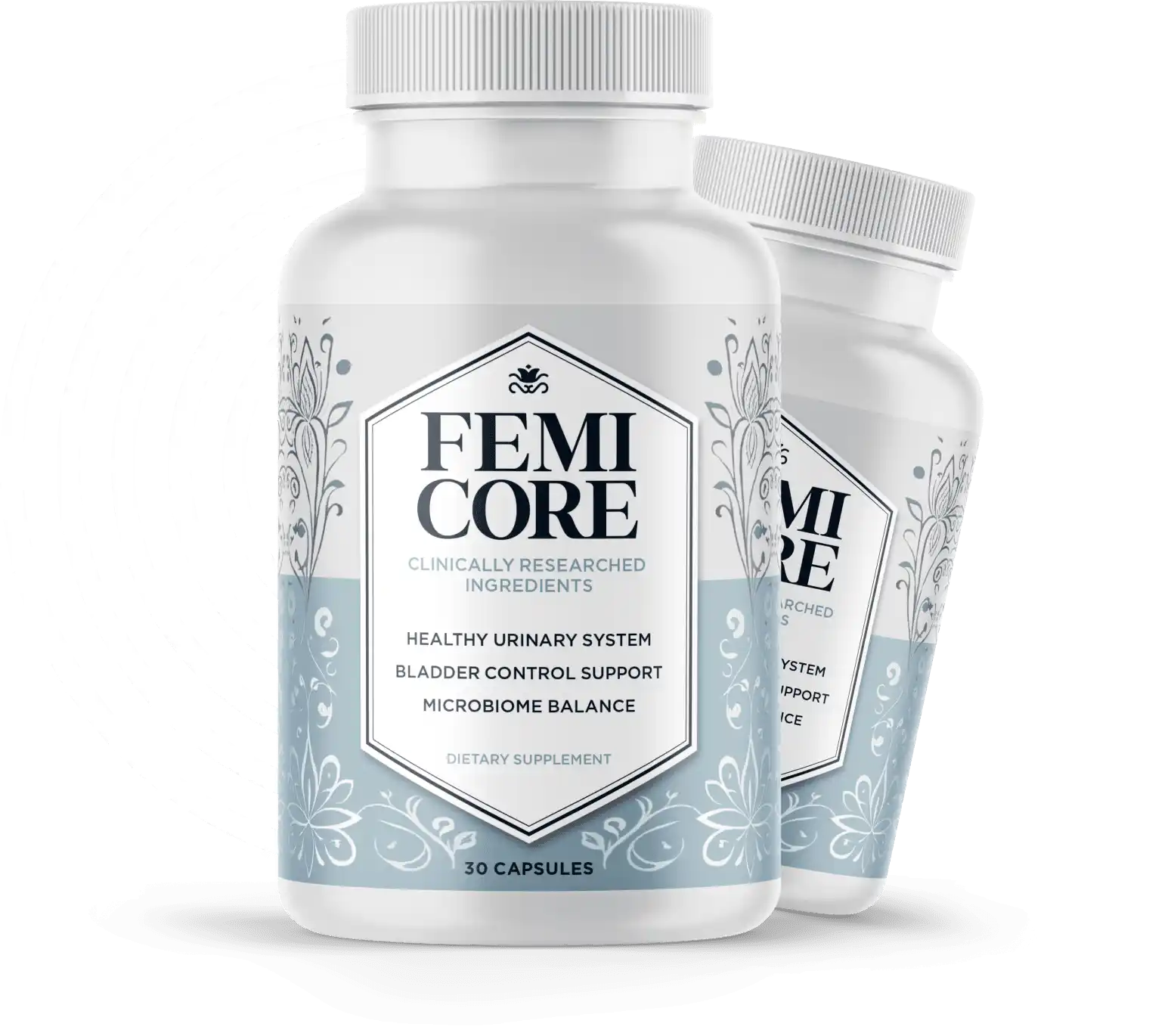
What Is FemiCore?
FemiCore is a once-daily dietary supplement capsule marketed for women experiencing bladder urgency, frequent urination, and urinary discomfort. The product is positioned around the “urinary microbiome”—the bacterial environment of the urinary tract—and combines four botanical extracts with five probiotic strains in a single capsule .
Each bottle contains 30 capsules, providing a 30-day supply. The formula is described as non-GMO, stimulant-free, and made in the USA . The seller’s pages name ClickBank as the retailer, and orders are processed through third-party checkout platforms .
Important clarification: FemiCore is not the same as “Femicur,” a separate Romanian product containing chasteberry for premenstrual symptoms. They are entirely different products with different ingredients and purposes.
What’s Known About the Ingredients
FemiCore uses a proprietary blend, meaning individual ingredient doses are not disclosed. The label lists two blend totals: a 350 mg Herbal Blend and a 50 mg Probiotic Blend .
The Herbal Blend
Cranberry Extract (standardized to 30% proanthocyanidins) is the most evidence-backed ingredient in the formula. A 2023 Cochrane review found cranberry products can reduce symptomatic UTIs in some groups, particularly women with recurrent infections. However, this benefit relates to infection prevention, not bladder urgency or leakage .
Bearberry (Uva Ursi) contains arbutin, which converts to a compound with antibacterial activity in urine. Traditional herbal practice limits uva ursi to short periods—typically 1–2 weeks at a time—due to potential liver effects with prolonged exposure. A daily, months-long formula containing bearberry is a significant safety consideration .
Berberine is a plant alkaloid with antimicrobial activity in lab settings. It can lower blood sugar and interact with some medications. Its role in bladder control is weakly supported .
Mimosa Pudica is used in traditional South Asian medicine. Laboratory and animal studies suggest effects on smooth muscle and inflammation, but human research is limited. It is the most distinctive ingredient and also the least proven .
The Probiotic Blend
The probiotic blend includes five Lactobacillus strains: L. crispatus, L. acidophilus, L. plantarum, L. gasseri, and L. casei .
Critical limitations:
- No CFU count is disclosed. Without knowing how many live bacteria are present, it is impossible to assess viability or compare to studied doses .
- Strain IDs are inconsistently reported. Some sources list strain codes (LCr86, LA88, N13, LG08, LC16), but these should be verified on the current bottle label .
- Two strain names are misspelled on the page (“Gaseri” and “Cassei”), which raises quality concerns .
How FemiCore Is Positioned to Work
FemiCore’s marketing claims the formula supports bladder control, reduces urgency, and restores urinary microbiome balance. The theory is that probiotic strains populate the urinary tract with beneficial bacteria while cranberry and botanicals reduce irritation and bacterial adhesion .
The seller’s FAQ adds that the formula targets “toxic dioxins that can throw your urinary microbiome out of balance,” and that its compounds “help prevent bladder leaks by repopulating your urinary microbiome with good bacteria” .
The evidence gap is substantial. No published clinical trial has tested the finished FemiCore product . The scientific support comes from studies on individual ingredients—often at different doses, different strains, and sometimes different delivery methods than what FemiCore provides.
Most importantly, no human trial shows that an oral Lactobacillus capsule recolonizes the bladder or reduces leaks. The strongest data for L. crispatus involves vaginal delivery, not oral capsules .
One review concluded: “FemiCore is FemiPro in a different box: a sensible recurrent-UTI formula sold with a bladder-control story the ingredients cannot deliver” .

What Users Are Reporting
Filtering out obvious affiliate content, user feedback reveals a consistent pattern.
Common positives reported:
- Fewer urinary discomfort episodes and a calmer bladder within a month or two
- Fewer UTI recurrences, which several reviewers describe as significant
- More confidence leaving the house without scouting bathrooms first
- The once-daily routine becoming part of the morning
Common complaints:
- “I felt nothing after two months” — a substantial share, concentrated among women with stress-type leaks (the mechanical kind caused by coughing, sneezing, or lifting), which this formula does not address .
- Price sensitivity relative to the evidence level
- Digestive adjustment in the first weeks (typical of probiotic starts) .
- Confusion about what the product actually treats—some expected help for prolapse or severe incontinence.
How to spot a fake review: Uniformly five-star with no downsides, miracle turnaround stories in implausible timeframes, and urgency language about stock are red flags. Genuine reviews mention leak type and timeline specifically, report mild partial improvement, and acknowledge side effects or price.
Pricing and Packages
FemiCore is available in tiered packages. Prices as of October 2026 :
| Package | Supply | Total | Per Bottle | Shipping |
|---|---|---|---|---|
| 2 Bottles | 60 days | $158 | $79 | $9.99 |
| 3 Bottles (2+1) | 90 days | $207 | $69 | Free |
| 6 Bottles (3+3) | 180 days | $294 | $49 | Free |
The manufacturer states purchases are one-time with no auto-ship or subscription . The 6-bottle package includes three digital bonuses (on marriage, digestion, and hip/leg mobility)—none related to bladder health, and their “retail values” should be ignored.
60-Day Money-Back Guarantee: The Procedural Reality
FemiCore offers a 60-day money-back guarantee, but the terms have inconsistencies that consumers should understand.
The process:
- The 60-day window starts from the delivery date confirmed by carrier tracking, not the order date .
- Refund requests go to contact@femicore-product.com with “Refund Request” in the subject line .
- All bottles—empty, partially used, or unopened—must be returned to an Ohio address .
- Return shipping is the customer’s responsibility.
- Refunds process within 5–10 business days after the package is received.
The critical contradiction: The seller’s refund page advises using FemiCore for at least 3 months before concluding it does not work. That is longer than the 60-day refund window. Consumers must decide early how they will judge the product and set a reminder well before day 60.
Key Limitations and Considerations
Proprietary blend hides doses. Individual ingredient amounts and probiotic CFU are not disclosed, making it impossible to compare against studied doses .
No product-specific clinical trials. The evidence supports individual ingredients in specific contexts, not the finished FemiCore formula .
Marketing outruns the science. The “bladder control” promise rests on extrapolation from UTI and correlation research. The formula may support urinary comfort for some women, but it will not fix stress leaks (the mechanical kind) .
Bearberry in a long-term daily formula. Traditional guidance limits uva ursi to short courses (1–2 weeks). A months-long daily product containing bearberry warrants a conversation with a doctor, particularly for anyone with liver history .
Pregnancy and nursing. Not appropriate—bearberry is specifically contraindicated, and probiotic/herbal safety data in pregnancy is insufficient .
Website fragmentation. Multiple nearly identical FemiCore websites exist, making it difficult to determine which represents the original brand .
Not a substitute for medical care. Bladder leaks accompany diabetes, neurological conditions, prolapse, and interstitial cystitis. Blood in urine, pain, fever, or new leaks always warrant a doctor’s visit before any supplement .
Frequently Asked Questions
Is FemiCore safe?
Generally well-tolerated, but bearberry’s presence in a daily long-term formula is a concern. Pregnant or nursing women should not use it. Consult a healthcare professional before use, especially if you have liver concerns or take medications .
Who should avoid FemiCore?
Pregnant or breastfeeding individuals, those under 18, individuals with liver or kidney concerns, and anyone taking cyclosporine, diabetes medication, or warfarin should consult a physician first .
Does FemiCore actually work for bladder control?
For urgency and irritation, some users report gradual improvement. For stress leaks (coughing, sneezing, lifting), it will not help—this is the most common source of disappointment .
How long until results are noticeable?
User feedback suggests 1–2 months for urinary comfort changes. The seller advises 3 months, but that exceeds the refund window .
Is there a subscription?
The manufacturer states it is a one-time purchase with no auto-ship. Verify on your order confirmation .
The Bottom Line
FemiCore is built around a genuinely interesting research area—the urinary microbiome—and includes cranberry, a well-studied ingredient for recurrent UTI prevention. The label discloses more than many direct-sold competitors, and the once-daily capsule is easy to maintain.
However, the marketing outruns the evidence by a wide margin. The “bladder control” promise is not supported by trials of the finished product. The probiotic blend has no CFU count and misspelled strain names. Bearberry appears in a long-term daily formula despite traditional limits on duration. And the refund policy creates a timing trap: the seller advises 3 months of use, but the guarantee expires at 60 days.
For women whose primary complaint is recurring urgency and irritation—who have been medically evaluated and cleared—FemiCore may be worth a cautious trial at the 3- or 6-bottle price, with a bladder diary and a calendar reminder for day 45. For stress incontinence, or for anyone who needs to know what a probiotic actually contains, the product does not answer the question. Pelvic floor physical therapy has dramatically more evidence behind it and is the first-line recommendation of every urogynecology guideline.
Important Disclaimer: This information is for informational purposes only and is not intended to diagnose, treat, cure, or prevent any disease. Statements regarding dietary supplements have not been evaluated by the U.S. Food and Drug Administration. Consult a qualified healthcare professional before using any dietary supplement or making significant changes to your diet, exercise, or wellness routine. Individual experiences may vary.