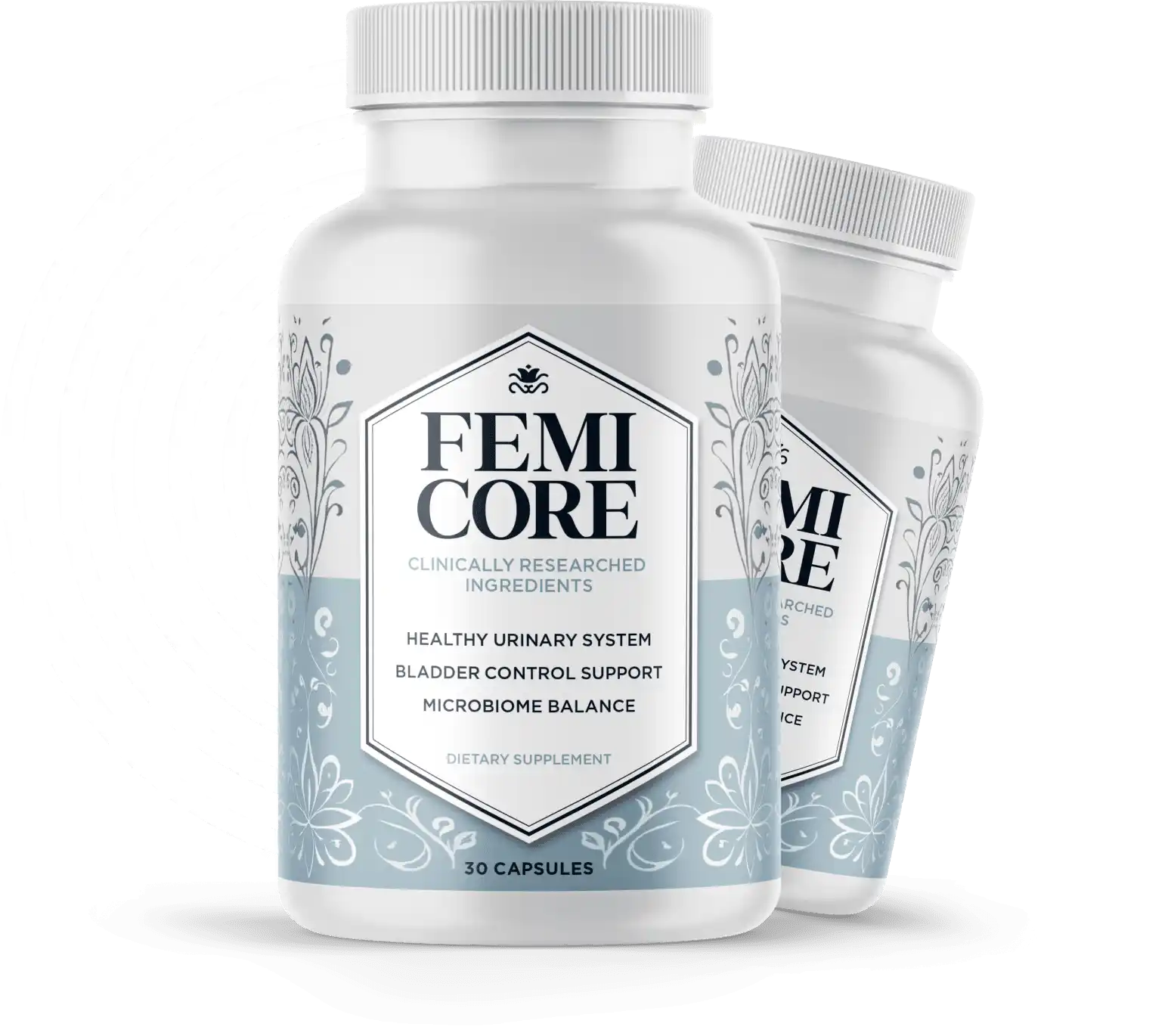
FemiCore is a once-daily capsule supplement marketed for women’s bladder control, urinary health, and “microbiome balance.” It is sold through ClickBank and promoted across a network of look-alike websites with widely varying trust scores. This review examines what the formula discloses, the evidence behind its ingredients and central mechanism, what independent assessments show, and the practical points buyers may want to verify before ordering.
A note on format and sourcing: FemiCore is a capsule, not a powder or liquid—one capsule daily with water, 30 per bottle. The product is sold primarily through its official website, with ClickBank named as the retailer of record. The brand has also publicly warned about counterfeit listings on marketplace sites, which is a critical sourcing consideration.
What FemiCore Claims to Offer
FemiCore is positioned as a bladder-support formula that targets a “urinary microbiome imbalance” allegedly responsible for involuntary muscle contractions and sudden leaks. The sales page describes it as a fit for “women over 45 who are struggling with uncontrollable pee leaks and a weak pelvic floor”.
The marketing goes further than general urinary support. The FAQ states that the formula targets “toxic dioxins” that throw the urinary microbiome out of balance, and that its compounds “help prevent bladder leaks by repopulating your urinary microbiome with good bacteria”. It also claims the formula “strengthens bladder muscles”. These are specific, disease-adjacent claims for a dietary supplement.
The product carries the standard FDA disclaimer stating it is not intended to diagnose, treat, cure, or prevent any disease. It is sold in 2-, 3-, and 6-bottle packages, with a 60-day money-back guarantee.
Ingredient Disclosure: Nine Names, No Individual Doses
FemiCore’s label discloses nine named ingredients in two blends, which is more than many competitors disclose:
- 350 mg Herbal Blend: Mimosa pudica seed extract, cranberry extract standardized to 30% proanthocyanidins, bearberry leaf (uva-ursi), and berberine hydrochloride extract (8%).
- 50 mg Probiotic Blend: Lactobacillus crispatus LCr86, L. acidophilus LA85, L. plantarum Lp05, L. gasseri LG08, and L. casei LC89.
Naming all five probiotic strains is a genuine positive relative to competitors that hide strains behind generic labels. However, the label gives no individual amounts for any herbal ingredient, and the probiotics are listed by weight (50 mg) with no CFU count—the colony-forming unit figure that actually matters for a probiotic. Without individual doses or CFU counts, neither efficacy nor safety can be compared with clinical research.
A separate transparency note: the label lists the distributor only as “FemiCore” at a returns warehouse in Tallmadge, Ohio—the same warehouse used by ProDentim—and the two products share order page, refund, and shipping policies. That shared infrastructure is not inherently problematic, but it means the brand is a marketing entity rather than a distinct manufacturer with a publicly identified facility.
Ingredient Evidence: Recognizable Components, Missing Target Evidence
The ingredient-by-ingredient picture is uneven. None of the ingredients has been tested for bladder leaks, and FemiCore itself has never been tested in a published clinical trial.
Cranberry extract has some evidence for helping prevent repeat UTIs, but that is a different outcome from bladder leaks and urgency. Bearberry (uva-ursi) is an herb intended for short-term use—a week at most, not the months the seller suggests. Mimosa pudica and berberine have limited human data for the specific claims being made. The Lactobacillus strains are named, which is better than most, but without CFU counts the delivered dose is unknown.
The “dioxins” and “urinary microbiome” narrative is scientifically shaky. The seller’s reference list includes news articles about tampons from major publications, a WHO page on dioxins, and studies of dioxin-like chemicals—materials that do not establish that a supplement can “repopulate” the urinary microbiome or prevent leaks. The urinary tract does have its own microbiome, but the leap from “the bladder has a microbiome” to “this capsule rebalances it and stops leaks” is not a leap any published trial of this formula has made.
One independent review scored the product 2.8 out of 5 (below average) , citing the lack of individual ingredient amounts, the absence of CFU counts, and the gap between the marketing narrative and the actual evidence.
visit femicore official website
Trust Assessments and Website Transparency
Independent trust assessments across FemiCore promotional domains produce inconsistent and mostly low scores:
- One domain received a Gridinsoft score of 12/100, classified as a fraudulent shop warning, with recurring complaints about payment without delivery, different products, or very inferior quality.
- Another received a ScamAdviser score of 24, with the assessment concluding “the website may be a scam”.
- A third received a Gridinsoft score of 35/100, flagged as a blacklist warning.
- A fourth received a ScamAdviser score of 41, with the assessment concluding it “might be a scam” and noting keywords suggesting the site is under construction or uses scam-typical phrasing.
- A fifth received a ScamAdviser score of 45, with the assessment “unsure if the website is legit” and flags for phishing and suspicious activity.
- A sixth received a Gridinsoft score of 55/100, described as “not currently looking like a confirmed scam” but with security-provider warnings and a malware/phishing blacklist detection.
The pattern is one of multiple look-alike domains with scores clustered between 12 and 55, none reaching a clearly trusted threshold. The most consequential practical issue is counterfeit risk: the maker has publicly warned about fake FemiCore sold on marketplace sites, and those knockoffs have unknown contents, no 60-day guarantee, and no refund path. The real product is sold only through the official website.
Marketing Approach and the Review Count Gap
The marketing follows a direct-response pattern with several documented features. Unverifiable social proof is the most visible: FemiCore’s own site claims a 4.5-star rating from 19,263 reviews, yet Trustpilot shows zero reviews for the domain. That gap is one of the clearest warning signs in online retail.
Misleading scientific citations are another flag. The page lists about two dozen references and name-drops respected publications, but the references cover studies of individual ingredients and urinary bacteria—not a trial of the FemiCore capsule itself. Naming a journal does not mean the product was studied there, or that the cited research supports the specific claim being made next to it.
Aggressive bundling and upsells push buyers toward the largest order. The 6-bottle bundle comes with three free bonus e-books, including one written to a woman about her husband—a framing that confirms the marketing is aimed at women. The checkout page displays crossed-out totals to anchor the discounted price as a bargain.
For buyers, the practical takeaway is to read the label, the pricing breakdown, and the refund terms on the specific checkout page used, rather than relying on the review count or the mechanism story.
Pricing and Refund Policy
Pricing is relatively transparent by ClickBank standards. As of October 1, 2026, the seller’s page listed:
- 2 bottles: $158 + $9.99 shipping ($79 per bottle)
- **3 bottles (2+1): $207** ($69 per bottle, free US shipping)
- **6 bottles (3+3): $294** ($49 per bottle, free US shipping, plus three digital guides)
The refund policy is a 60-day money-back guarantee, processed through ClickBank. The terms require mailing back all bottles—empty or not—and the packing slip at the buyer’s own cost; the seller does not pay return shipping. Contact is via a vendor email address and phone numbers, with no verifiable corporate entity behind them.
Two practical notes: first, the refund page advises using FemiCore for at least 3 months before concluding it does not work—longer than the 60-day refund window, which is a structural mismatch worth noting. Second, counterfeit purchases on marketplaces are not covered by ClickBank’s refund route, because ClickBank can only refund orders it processed.
Customer Feedback: Thin and Complicated by Counterfeits
Public feedback on FemiCore is thin and difficult to verify independently. The product launched recently and has no long public track record of verified customer reviews. The vendor’s own site displays testimonials, but these cannot be independently verified, and the review count gap described above undermines confidence in their authenticity.
What does exist is structural evidence rather than a body of verified user experience. One independent complaint analysis summarized the situation: “The complaints that hold up are about disclosure, not danger: no published doses, inconsistent shipping lines, and a sales page that promises more than the ingredient research does. The product itself is real, ships, and the 60-day refund is honoured through ClickBank”.
That same analysis noted that counterfeit marketplace listings are the single most concrete way buyers get burned, and that complaints from marketplace buyers often reflect the knockoff rather than the real product. On the genuine-product side, shipping descriptions are inconsistent—one official page says free shipping on all packs, while the order page shows roughly $9.99 on smaller packs.
Frequently Asked Questions
Is FemiCore a legitimate product?
FemiCore is a real capsule supplement sold through ClickBank, with a published nine-ingredient label, a 60-day refund policy, and a retailer that processes refunds independently of the seller. It is not a scam in the sense of taking money and delivering nothing. The main considerations are disclosure-related: no individual doses, no CFU counts, no published trial of the finished formula, a large review-count gap between the sales page and Trustpilot, and counterfeit risk on marketplaces.
What are the ingredients?
The formula contains a 350 mg herbal blend of Mimosa pudica, cranberry extract (30% PAC), bearberry, and berberine HCl (8%), plus a 50 mg probiotic blend of five named Lactobacillus strains. No individual herbal amounts and no probiotic CFU count are published.
Do the ingredients work for bladder leaks?
None of the ingredients has been tested for bladder leaks, and the finished formula has never been clinically tested. Cranberry may help prevent repeat UTIs, but that is a different outcome. Bearberry is intended for short-term use (a week at most), not months. The “dioxin” and “urinary microbiome” story is not supported by robust clinical evidence for a swallowed capsule.
Is it safe?
The ingredients are generally recognized as safe at typical amounts, but individual doses are undisclosed, which makes interactions unpredictable. Bearberry should not be used long-term. Independent guidance advises skipping FemiCore if you take metformin, a statin, a blood thinner, or cyclosporine, or if you are pregnant or breastfeeding. Anyone with a medical condition or on medication should consult a doctor first.
How much does it cost?
$79 per bottle** on the 2-bottle pack ($158 + $9.99 shipping), **$69 per bottle on the 3-bottle pack ($207), and **$49 per bottle** on the 6-bottle pack ($294, free shipping). There is no single-bottle option.
What is the refund policy?
A 60-day money-back guarantee applies to orders through ClickBank. You must mail back all bottles at your own cost and include the packing slip. Note that the refund page advises 3 months of use, which exceeds the 60-day window. Marketplace purchases are not covered by ClickBank’s refund route.
Who makes FemiCore?
The label says “Distributed By: FemiCore” and lists a Tallmadge, Ohio returns warehouse—the same one used by ProDentim. No verifiable manufacturing facility or corporate founder is publicly identified. Buyers should check the bottle label on arrival.
Is it available in stores?
FemiCore is sold primarily through its official website and ClickBank, not mainstream retail. The maker has warned about counterfeit listings on marketplaces, so verifying the purchase channel is essential.
Points to Consider
- Doses are entirely undisclosed. Nine ingredients across two blends, with no individual herbal amounts and no probiotic CFU count.
- No finished-product trial exists, and no ingredient has been tested for bladder leaks.
- Trust scores are low and inconsistent across domains: 12 (Gridinsoft), 24 (ScamAdviser), 35 (Gridinsoft), 41 (ScamAdviser), 45 (ScamAdviser), 55 (Gridinsoft).
- Review count gap: the site claims 19,263 reviews at 4.5 stars; Trustpilot shows zero.
- Counterfeit risk is real: marketplace listings are not the genuine product and have no refund path.
- Refund timeline mismatch: the refund page advises 3 months of use, but the window is 60 days.
Who FemiCore May Suit
FemiCore may appeal to women who are comfortable with a probiotic-plus-botanical capsule, who have already tried free first-line measures (pelvic floor work, bladder retraining, reducing evening irritants), and who are willing to verify the purchase channel and refund terms before ordering. The ClickBank refund route provides a layer of consumer protection for genuine orders.
It is less suited to buyers who want disclosed doses that match clinical research, a finished-product trial, a mechanism consistent with urology, or who are relying on it to address stress incontinence (leaks when coughing, sneezing, or lifting)—nothing in a capsule rebuilds a pelvic floor. It is also not suitable for anyone on metformin, statins, blood thinners, or cyclosporine, or who is pregnant or breastfeeding.
Women with persistent urinary symptoms should consider a medical evaluation first—a urologist or urogynecologist can diagnose treatable causes, and pelvic floor physical therapy is a well-evidenced treatment for many women with leakage and urgency.
Final Assessment
FemiCore sits in the gray zone common to affiliate-sold supplements: commercially real, scientifically unproven. The product exists, ships, ClickBank processes orders, and a 60-day refund route is genuine for purchases through the official funnel. The label names all nine ingredients and all five probiotic strains—a transparency positive relative to many competitors.
The limitations are substantial and product-level: no individual doses and no CFU counts, no published trial of the finished formula, a “dioxin” and “urinary microbiome” narrative that outstrips the evidence, a review-count gap between the sales page and Trustpilot, trust scores ranging from 12 to 55, counterfeit marketplace risk, and a refund page that advises 3 months of use against a 60-day window.
For buyers, a measured approach makes sense: purchase only through the official ClickBank funnel, avoid marketplace listings, keep the order email, set a refund reminder before day 60, and set expectations at “modest support at best” for urgency and frequency—not for stress incontinence. FemiCore does not replace medical evaluation or pelvic floor therapy, and nothing in the available evidence suggests it should.