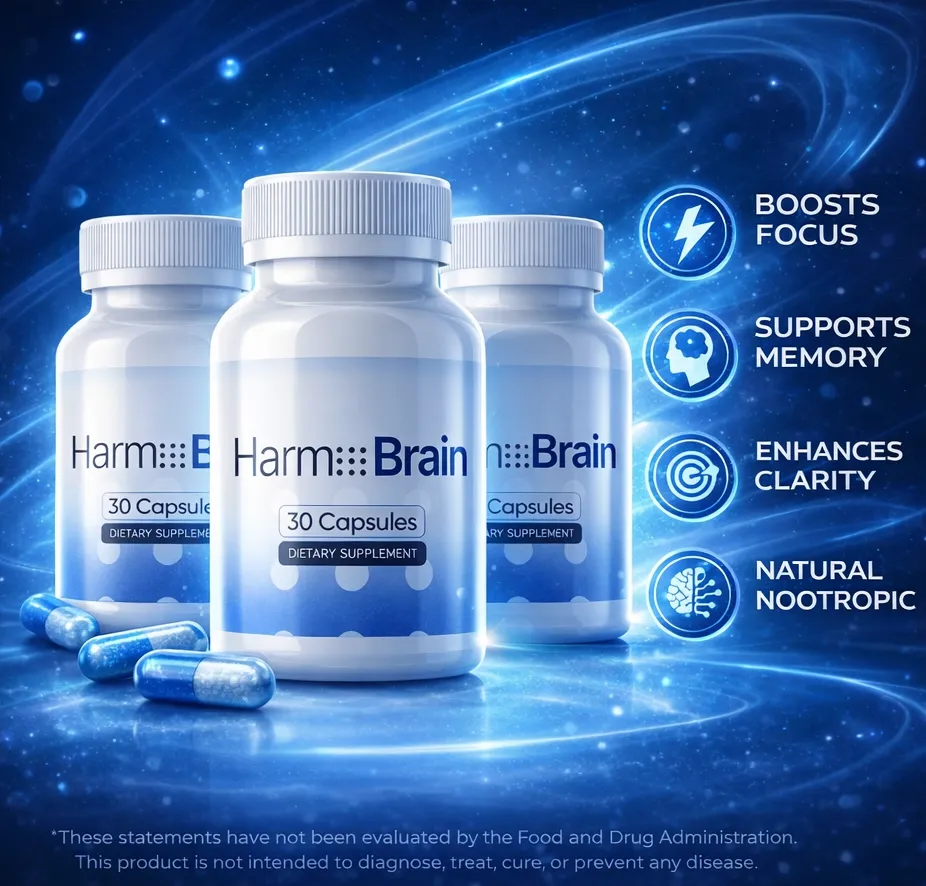
What Is Harmo Brain?
Harmo Brain is marketed as a daily nootropic capsule for memory, focus, and mental clarity. The product is positioned as a stimulant-free, 12-ingredient cognitive support formula with a 60-day money-back guarantee.
However, a critical distinction must be made upfront: Harmo Brain is not a single, clearly defined product from a transparent manufacturer. Investigations have identified multiple conflicting ingredient lists, brand names, domain names, and even scam classification levels associated with the Harmo Brain label. The marketing relies heavily on AI-generated deepfake videos featuring fabricated endorsements from public figures, and independent security tools have assigned trust scores as low as 0 out of 100 to domains selling the product .
One source of confusion: the product name appears variously as “Harmo Brain,” “HarmoBrain,” and “Harmos Brain” across different domains, each with different ownership details and trust profiles.
What’s Known About the Ingredients
The ingredient information for Harmo Brain is inconsistent across sources, which is a significant red flag in itself.
Infoquu lists the formula as containing Magnesium Glycinate, Alpha-Lipoic Acid, L-Carnitine, Turmeric Extract (95% Curcuminoids), Coenzyme Q10 (CoQ10), and Butcher’s Broom . The same source notes that while several of these ingredients have individual research supporting specific cognitive or neurological functions, no published human clinical trials have evaluated HarmoBrain as a complete formula .
Consumer Health Digest (French edition) lists a different ingredient set: Turmeric Extract, CoQ10, L-Carnitine, and Magnesium Glycinate . This overlaps partially with the Infoquu list but omits Alpha-Lipoic Acid and Butcher’s Broom.
A separate forum post from a user who claims to have ordered the product reports that “the actual ingredients were the usual herbs,” suggesting the delivered product did not match the marketing claims about specific extracts .
Critical limitations:
- Inconsistent ingredient panels. Different sources list different formulas, suggesting the product formula may change frequently or that promotional materials are unreliable.
- No dosage disclosure. The manufacturer does not publish exact milligram amounts for individual ingredients, making it impossible to verify whether the formula contains clinically meaningful doses .
- No product-specific clinical trials. The evidence cited describes studies on individual ingredients, not the finished Harmo Brain formulation .
How Harmo Brain Is Positioned to Work
Harmo Brain’s marketing claims are extraordinary and, according to multiple investigations, unsupported by credible evidence.
The promotional narrative has been disseminated through AI-generated deepfake videos designed to look like legitimate news reports. One forum user described watching what appeared to be a CBS news program featuring “Dr Phil interviewing a supposedly MD/Phd former head researcher at Pfizer” discussing dementia and Parkinson’s research, followed by “convincing interviews with Dr Oz, Warren Buffett, Dolly Parton, George Bush and a Nobel winning neuroscientist” endorsing the product. The user later discovered “the whole thing is AI deepfake” .
A YouTube investigation separately documented unauthorized AI depictions of Dr. Dale Bredesen, “60 Minutes” correspondents, Bill Gates, Steve Martin, Michael Caine, Morgan Freeman, and Jane Pauley in ads promoting Harm Brain (a closely related name). The investigation concluded that “Harm Brain is nothing more than a rebranded scam product fraudsters designed to defraud elderly buyers” .
The reality: No peer-reviewed clinical study, medical endorsement, or published evidence supports the claim that Harmo Brain can improve memory, prevent cognitive decline, or treat any neurological condition. Dietary supplements are not FDA-approved for treating any medical condition. Claims suggesting otherwise are misleading and potentially dangerous, as they may delay individuals from seeking proper medical care.
What Users Are Reporting
Independent, verifiable user feedback for Harmo Brain is virtually nonexistent, and the feedback that does exist raises serious concerns.
A forum user who ordered the product reported: “Stunned to see I was billed for a six month supply plus bottled of a sleep aid and eye vitamins. Almost $600. The actual ingredients were the usual herbs all that stuff has.” The user stated they were “luckily able to cancel everything” but described being “embarrassed that I got sucked in” .
JVZoo affiliate data for Harmo Brain shows refund rates ranging from 4.55% to 33.33% across different package options, with the core 6-bottle package showing a refund rate of 13.24% and the 3-bottle package showing 12.68%. The 2-bottle package had a notably high refund rate of 23.75% . These figures indicate that a meaningful share of buyers are requesting refunds.
The marketing pages display five-star testimonials, but these appear exclusively on the seller’s own sites and cannot be independently verified. One review source noted: “Without verifiable feedback on independent platforms, you cannot trust five-star ratings hosted directly by the seller” .

Pricing and Packages
Harmo Brain pricing varies significantly across domains and affiliate funnels. According to JVZoo affiliate data, the core packages are sold at the following average prices :
| Package | Supply | Average Price |
|---|---|---|
| 2 Bottles | 60 days | $177.48 |
| 3 Bottles | 90 days | $215.40 |
| 6 Bottles | 180 days | $293.61 |
The JVZoo data shows the 6-bottle package has sold over 5,500 units, while the 3-bottle package has sold over 1,000 units and the 2-bottle package over 250 units .
The sales pages employ countdown timers, “limited stock” warnings, and tiered discounts to pressure consumers into quick purchases. One security analysis characterized the “buy more, get more” discount tactic as “a deliberate pressure tactic designed to make you spend more before you think” .
Website Trust Concerns Across Multiple Domains
This is the most important section of this review.
Multiple domains selling Harmo Brain have received extremely low trust scores from independent security tools.
ScamAdviser analysis of harmosbrain.us returned a trust score of 4 out of 100, with the summary: “harmosbrain.us has a very low trust score which indicates that there is a strong likelyhood the website is a scam. Be very careful when using this website!” The analysis noted the site was reported for Phishing by IPQS, was reported as Suspicious by IPQS, uses free email addresses for contact, has a high number of suspicious websites on the same server, and is “very young.” The domain was only 2 months old at the time of analysis .
ScamAdviser analysis of myharmobrain.online returned a trust score of 0 out of 100, with the summary: “has a very low trust score which indicates that there is a strong likelyhood the website is a scam.” The site was also reported for Phishing by IPQS and registered only recently, with hidden WHOIS data .
ScamAdviser analysis of harmobrain-us.online returned a trust score of 29 out of 100, noting the site is “very young” and has low traffic. The summary stated: “the website may be a scam” .
Checknetsafe.nz analysis of the primary domain found that it was registered on December 2, 2025, giving it “almost zero track record.” The analysis noted the site “hides its final sales pages behind redirects, a common trick in supplement funnels” and “relies on vague ‘brain health’ claims without providing independent clinical proof” .
A Nextdoor community alert warned users about an AI-generated “CBS Sunday Morning” video promoting the product, stating: “This video below of ‘CBS Sunday Morning’ is NOT real. It is an AI generated ‘interview’ and is trying to get you to purchase a product” .
What this means for consumers: The combination of AI deepfake marketing, fabricated endorsements from public figures, trust scores as low as 0 and 4 out of 100, phishing flags from IPQS, hidden ownership, and very young domain age creates a high-risk profile. This is not a case of a legitimate product with exaggerated marketing—the core promotional materials themselves are fabricated.
Key Limitations and Considerations
AI deepfake marketing. The product is promoted through fabricated videos using unauthorized likenesses of Dr. Phil, Dr. Oz, CBS News, and other public figures .
Website trust scores are extremely low. Multiple domains selling Harmo Brain have received trust scores of 0, 4, and 29 out of 100, with phishing flags from IPQS .
Inconsistent ingredient lists. Different sources list different formulas, and a user who ordered the product reported receiving “the usual herbs” rather than the claimed extracts .
No product-specific clinical trials. The evidence supports individual ingredients, not the finished formulation .
Aggressive upsell tactics. The product is part of a sales funnel that includes up to 29 other products, and users report being billed for unexpected items .
Refund rates are meaningful. JVZoo data shows refund rates ranging from 4.55% to 33.33%, indicating that a significant share of buyers are dissatisfied .
Not a substitute for medical care. Harmo Brain is a supplement, not a treatment for Alzheimer’s, dementia, or any neurological condition. Relying on it instead of seeking professional medical evaluation could be harmful.
Frequently Asked Questions
Is Harmo Brain safe?
The product contains undisclosed ingredient doses and has no published safety data. Given the lack of transparency about manufacturing and quality control, safety cannot be assured. Consult a healthcare professional before use.
Does Harmo Brain actually work for memory?
No credible evidence supports its claims. The marketing narrative about cognitive benefits is promoted through AI deepfakes and fabricated endorsements. While some individual ingredients have modest research support, the finished Harmo Brain product has not been clinically tested .
Is Harmo Brain a scam?
Multiple independent security tools classify the websites selling it as probable scams, with trust scores as low as 0 and 4 out of 100 and phishing flags from IPQS . The use of AI deepfake videos and fabricated celebrity endorsements are hallmarks of fraudulent marketing .
Where should I buy Harmo Brain?
Given the severe red flags documented above, purchasing Harmo Brain is not recommended. If you are investigating cognitive support supplements, look for products from established manufacturers with transparent ingredient dosing, published third-party testing, and verifiable independent reviews.
Is there a money-back guarantee?
A 60-day guarantee is advertised, but given the scam classifications and website concerns, its enforceability is highly questionable.
The Bottom Line
Harmo Brain is not a legitimate cognitive supplement. It is a product marketed through AI-generated deepfake videos, fabricated endorsements from public figures, and unproven medical claims. Independent security tools have assigned trust scores as low as 0 and 4 out of 100 to domains selling the product, with phishing flags from IPQS .
The formula’s ingredient disclosure is inconsistent and incomplete, with no dosage information and no product-specific clinical trials. A user who ordered the product reported being billed nearly $600 for unexpected items and receiving “the usual herbs” rather than the claimed extracts . JVZoo data shows refund rates reaching as high as 33.33% for some package options .
For anyone concerned about memory, focus, or cognitive health—especially older adults who are the primary target of these marketing campaigns—the responsible path is to consult a qualified healthcare professional. No supplement sold through AI deepfake funnels can replace proper medical evaluation and evidence-based care.
Do not purchase Harmo Brain. If you have already purchased it, consider contacting your payment provider to discuss your options, and consult a healthcare professional if you have concerns about ingredients you may have consumed.
Important Disclaimer: This information is for informational purposes only and is not intended to diagnose, treat, cure, or prevent any disease. Statements regarding dietary supplements have not been evaluated by the U.S. Food and Drug Administration. Consult a qualified healthcare professional before using any dietary supplement or making significant changes to your diet, exercise, or wellness routine. Individual experiences may vary.