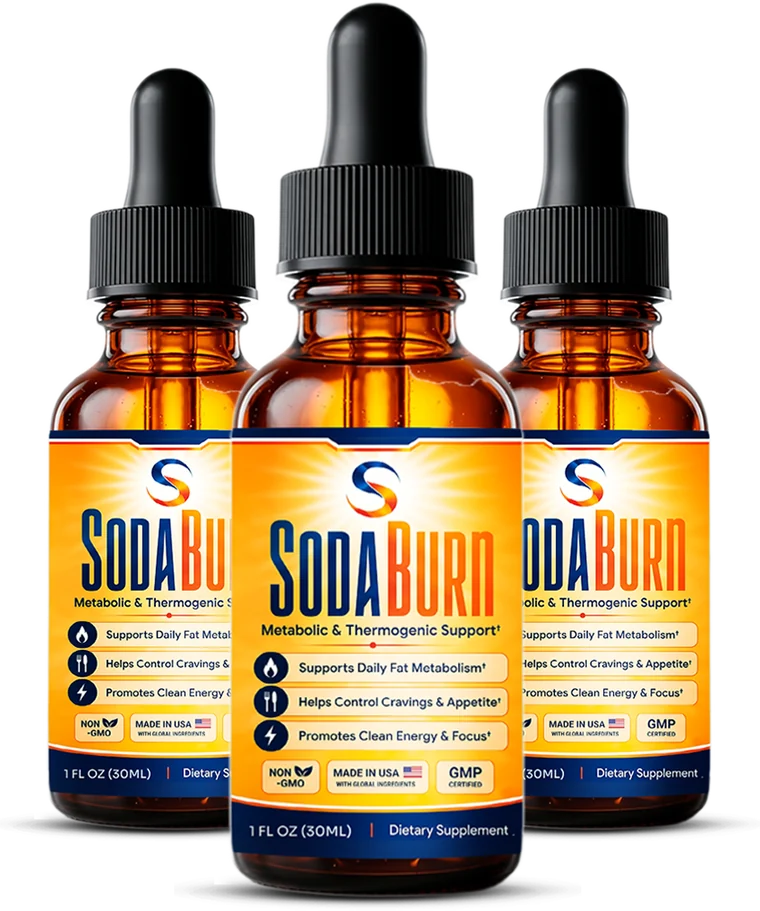
SodaBurn: A Balanced Review
SodaBurn is a liquid dropper supplement marketed for metabolism support, appetite control, and weight management. It is sold through a fragmented network of seller pages, with trust ratings that range from “moderate risk” to outright warnings. This review examines what the product actually discloses, the evidence behind its ingredients, what independent assessments show, and the practical points buyers may want to verify before ordering.
A note on format and sourcing: SodaBurn is a liquid dropper, taken once daily, with approximately 30 servings per bottle . The brand is sold through numerous separate seller pages, and the most consequential fact for any prospective buyer is that the formula and labeling are not consistent across channels—some pages describe a probiotic blend, while others list a stimulant-based thermogenic formula . Confirm which product you are actually ordering.
What SodaBurn Claims to Offer
SodaBurn is positioned as a convenient liquid supplement designed to support metabolism, thermogenesis, appetite control, and healthy weight management . The marketing emphasizes the liquid format as an alternative for people who dislike swallowing capsules, and describes a simple once-daily routine taken in the morning .
The formula commonly listed on official pages contains six named ingredients: chromium, African mango seed extract, green tea leaf extract, guarana seed extract, maca root extract, and grape seed extract . Chromium is included for blood-sugar and appetite support, green tea and guarana provide naturally occurring caffeine for thermogenesis and energy, and the botanicals are positioned for satiety and antioxidant support . The product is described as manufactured in the United States in an FDA-registered facility following Good Manufacturing Practice standards—though this does not mean the finished supplement is FDA-approved .
The most significant transparency gap is immediate: individual milligram quantities for the six active ingredients are not published on the current online label . Buyers cannot compare the doses against clinical research, and one independent analysis noted that the “microscopic amount of individual botanicals within the proprietary blend may be insufficient to trigger significant metabolic or thermogenic shifts” .
Ingredient Evidence: Recognizable Components, Formula-Level Gaps
The named ingredients are not inherently fraudulent—they are recognizable compounds with varying levels of research behind them. The limitation is that doses are undisclosed, and no clinical trial of the complete SodaBurn formula was identified .
Green tea extract contains catechins and caffeine that have been studied for modest effects on energy expenditure and fat oxidation. Guarana is a natural caffeine source, which can provide a stimulant effect but also carries risks of jitteriness and sleep disruption, especially when combined with other caffeine sources. African mango has been studied for appetite signaling and weight management, but evidence is limited and inconsistent. Chromium has a role in insulin function, though its independent impact on weight reduction is described as limited. Maca root and grape seed extract have antioxidant and energy-related research contexts, but no studies have tested them as part of this specific formula.
The critical distinction is between ingredient-level research and evidence for the finished product. One independent review stated it plainly: “The evidence surrounding individual ingredients varies, and knowing that an ingredient is included in a supplement does not automatically establish that the finished product will produce a specific outcome” . A separate analysis noted that “the finished SodaBurn formula itself does not appear to have undergone any independent, peer-reviewed clinical trials to prove its effectiveness or safety for weight management” .

Trust Assessments and Seller Transparency
Independent trust assessments across SodaBurn seller pages produce widely inconsistent and concerning ratings—a pattern that requires attention.
- One primary seller page received a ScamAdviser trust score of 56, described as “might be a scam,” flagged for low traffic, offering products commonly sold by scammers, and a very young domain (1 month old at assessment) .
- A variant seller page received a Gridinsoft trust score of 0, flagged for low traffic, recent registration, and products popular among scammers .
- The main seller domain received a Gridinsoft score of 12/100, classified as a “Suspicious Shop” with a blacklist detection, a 3-month-old domain, and no established public review history .
- A MalwareTips scan gave the domain a Safety Score of 64/100 (Moderate Risk), noting the domain was only 3 months old and that legal, privacy, returns, and contact links redirected to another domain, reducing transparency .
- A third variant received a Gridinsoft score of 27/100, described as a “Suspicious Website” with a 2-month-old domain .
- A free-hosted promotional page received a Gridinsoft score of 25/100, flagged for redirecting to the main seller domain .
The pattern is one of multiple look-alike seller pages with scores ranging from 0 to 56, all sharing characteristics of recent registration, low traffic, and hidden ownership. The main seller page may be the legitimate source, but buyers landing on promotional pages risk ordering through channels that may not honor refunds or deliver the genuine product. Confirm which seller you are ordering from before entering payment details .
Pricing and Refund Policy
Pricing for SodaBurn is relatively consistent across the sources that publish it, as of late 2026:
- 2 bottles: $158 total ($79 per bottle) + $9.99 shipping
- 3 bottles: $207 total ($69 per bottle), free shipping
- 6 bottles: $294 total ($49 per bottle), free shipping
The 60-day money-back guarantee is advertised, but the terms are more restrictive than the headline suggests. The captured policy states that the trial period is at least 30 days, returns must be initiated within 60 days, only sealed bottles are eligible, the buyer pays return shipping, and a 20% restocking fee is deducted from the refund . Refunds go to the original payment method and take 5–10 business days .
Two practical notes: the sealed-bottle restriction means an opened product may not qualify, and the 30-day minimum trial means you cannot request a refund immediately. Buyers should confirm the written terms on the specific checkout page used, since terms can change and vary across seller pages .
Customer Feedback: Thin and Difficult to Verify
Public feedback on SodaBurn is extremely limited on independent platforms. One Trustpilot profile shows a 3.4/5 rating from a single review, which states: “The soda burn drops are easy to take, and I like the convenience. I haven’t noticed enough of difference yet, so I’ll need more time to evaluate the product” . A separate Trustpilot profile for a different seller page shows zero reviews .
The official sales pages contain customer testimonials describing experiences with appetite, energy, and weight management, but the product’s own disclaimer states that testimonials may not represent typical buyer experiences . The absence of a substantial independent review footprint means buyers are evaluating the product primarily on its marketing claims, the trust profiles of seller pages, and the ingredient list rather than on a track record of verified user outcomes .
Frequently Asked Questions
Is SodaBurn a legitimate product?
SodaBurn is a real liquid supplement that is sold and delivered, and current official channels describe purchases as one-time transactions rather than automatic subscriptions . It is not a scam in the sense of taking money and delivering nothing. The main concerns are undisclosed doses, inconsistent formulas across seller pages, trust scores as low as 0 on some variants, and a refund policy with restrictive conditions .
What are the ingredients?
The current official formula lists chromium, African mango seed extract, green tea leaf extract, guarana seed extract, maca root extract, and grape seed extract . However, individual milligram amounts are not published online . Some seller pages have described a different, probiotic-based formula, so the label on the bottle received is the only reliable guide .
Do the ingredients work for weight loss?
The named ingredients have ingredient-level research for modest effects on metabolism and appetite, but the finished SodaBurn formula has not been clinically tested, and doses are undisclosed . One analysis noted that the amounts in the proprietary blend may be insufficient to produce meaningful metabolic shifts . The realistic expectation is modest support at best, alongside diet, activity, and sleep.
Is it safe?
The ingredients are generally recognized as safe at typical amounts, but the product contains caffeine from green tea and guarana, and the total caffeine amount per serving is not published . The manufacturer advises consulting a healthcare professional before use if you are pregnant, breastfeeding, under 18, have a medical condition, or take medication for diabetes, high blood pressure, or heart problems . Caffeine-sensitive individuals should account for their total intake.
How much does it cost?
**$158 for two bottles** ($79/bottle + shipping), **$207 for three** ($69/bottle), and **$294 for six** ($49/bottle), with free shipping on the larger packages .
What is the refund policy?
A 60-day money-back guarantee is advertised, but the terms include a 30-day minimum trial, sealed-bottle eligibility, buyer-paid return shipping, and a 20% restocking fee . Confirm the written terms at checkout, as they vary across seller pages .
Who makes SodaBurn?
The seller is listed as SodaBurn Research, with support via an email address . A specific manufacturing facility or corporate founder was not independently verified in the available sources. The seller pages are recent registrations with hidden ownership on several variants .
Is it available in stores?
SodaBurn is sold online through promotional seller pages, not mainstream retail. Given the multiple look-alike pages with trust scores as low as 0, buyers should confirm the purchase channel carefully and avoid pages that redirect to other domains or lack clear contact and refund information .
Points to Consider
- Doses are undisclosed. Six ingredients are named, but individual milligram amounts are not published, preventing comparison with research .
- Formulas conflict across seller pages. Some pages describe a probiotic formula, others a stimulant-based thermogenic formula—the product you receive may not match the page you ordered from .
- Trust scores range from 0 to 56 across seller pages, with several flagged for hidden ownership, recent registration, and suspicious-shop classification .
- Refund terms are restrictive: 30-day minimum trial, sealed-bottle requirement, buyer-paid return shipping, and a 20% restocking fee .
- Caffeine content is unpublished, and the product contains green tea and guarana .
- No substantial independent review footprint exists; the single Trustpilot review is neutral and early .
Who SodaBurn May Suit
SodaBurn may appeal to adults who prefer a liquid dropper format over capsules, who want a simple once-daily routine, who are comfortable with a formula that contains natural caffeine, and who are willing to verify the seller, label, and refund terms very carefully before ordering.
It is less suited to buyers who want disclosed doses that match clinical research, a finished-product clinical trial, a consistent formula across sellers, independently verifiable customer reviews, or a refund without restocking fees and return-shipping costs. Anyone who is pregnant, breastfeeding, under 18, caffeine-sensitive, or on medication for diabetes, blood pressure, or heart conditions should consult a doctor before use .
Final Assessment
SodaBurn is a real liquid supplement sold through a fragmented and low-trust web presence, with undisclosed doses and inconsistent formulas across sellers. The product exists, ships, and some seller pages describe purchases as one-time transactions . The named ingredients have modest research contexts.
The limitations are significant and structural: individual doses are not published, formulas conflict across seller pages, trust scores range from 0 to 56, refund terms carry a 20% restocking fee and sealed-bottle restriction, and independent customer feedback is nearly absent . The marketing’s own acknowledgment that testimonials may not represent typical experiences is a useful anchor .
For buyers, a measured approach makes sense: confirm the seller and the exact formula on the bottle, verify the refund terms at checkout, avoid any seller page with a trust score below 20, account for the caffeine content, and set expectations at “modest support at best” given the evidence gaps. SodaBurn is not a proven weight-management solution, and the fragmented web presence is a risk that should be weighed carefully before committing money.